 01535c2042
When an agent goes bankrupt, the simulation can now restart for another episode while preserving the scratchpad from the previous attempt. This lets us measure whether LLMs can learn from failure via persistent notes. Each episode gets its own SQLite DB (*.ep1.db, *.ep2.db, ...) so plotting scripts and post-hoc analysis work unchanged. The rollout JSON aggregates per-episode transcripts, turns, and costs. Key changes: - --max-episodes CLI flag (default 1, fully backward compatible) - Per-episode DB files when max_episodes > 1 - Scratchpad read from old DB, written into fresh DB between episodes - RunState tracks episode results with finish_episode/reset_for_new_episode - Agent prompt tells it about the episode number and to read its scratchpad - Plotting script for multi-episode fund curves + scratchpad evolution Co-Authored-By: Claude Opus 4.6 <noreply@anthropic.com> |
||
|---|---|---|
| imgs | ||
| plots | ||
| results | ||
| scripts | ||
| src/yc_bench | ||
| system_design | ||
| .DS_Store | ||
| .gitignore | ||
| pyproject.toml | ||
| README.md | ||
| start.sh | ||
| uv.lock | ||
 YC-Bench
A long-horizon deterministic benchmark for LLM agents. The agent plays CEO of an AI startup over a simulated 1–3 year run, operating exclusively through a CLI tool against a SQLite-backed discrete-event simulation.
The benchmark tests whether agents can manage compounding decisions: prestige specialisation, employee allocation, cash flow, and deadline risk — sustained over hundreds of turns.
Setup
Prerequisites
- Python 3.12+
uv
Install
git clone <repo-url>
cd YC_Bench
uv sync
API key
# .env  (any LiteLLM-compatible provider)
ANTHROPIC_API_KEY="sk-ant-..."     # for anthropic/claude-*
GEMINI_API_KEY="AIza..."           # for gemini/gemini-*
OPENROUTER_API_KEY="sk-or-v1-..."  # for openrouter/*
OPENAI_API_KEY="sk-..."            # for openai/*
Run
uv run yc-bench run \
  --model gemini/gemini-3-flash-preview \
  --seed 1 \
  --config medium
Outputs a SQLite DB in db/ and a JSON rollout in results/.
Run multiple models in parallel
bash scripts/run_benchmark.sh --seed 1 --config hard
How it works
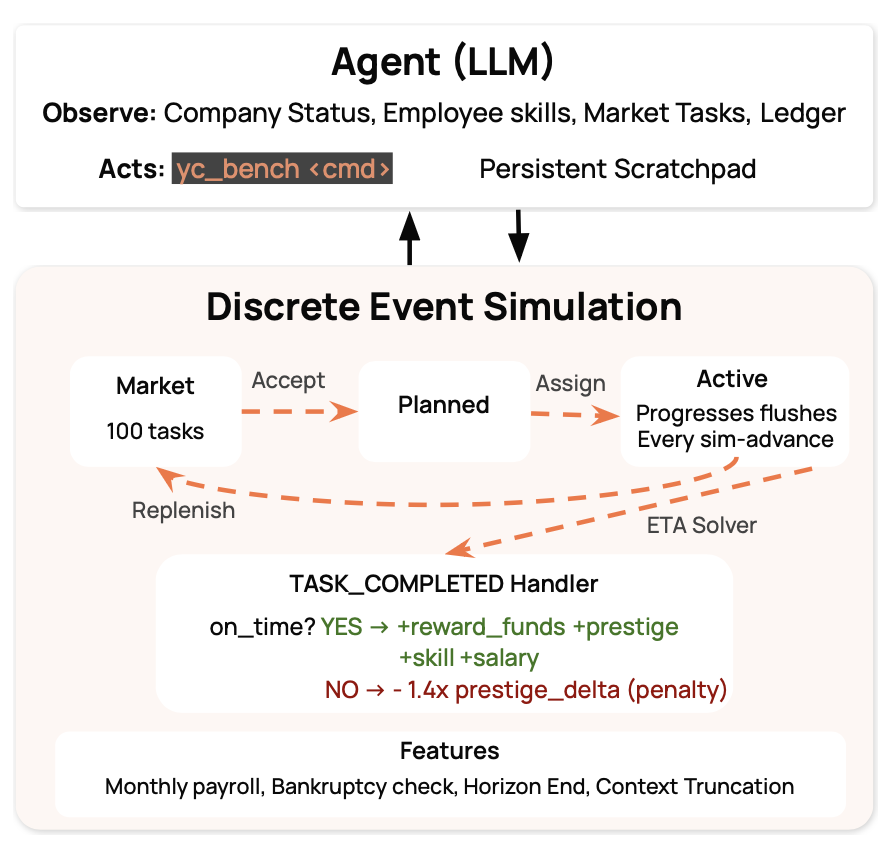
Core loop
- Agent calls
yc-bench sim resumeto advance time to the next event or monthly payroll. - The engine flushes task progress, applies prestige decay, fires due events, applies payroll.
- Agent reads wake events and decides: accept tasks, assign employees, dispatch, cancel.
- Repeat until bankruptcy or horizon end.
The simulation ends on bankruptcy (funds < 0 after payroll), horizon end (1–3 years), or max turns (if configured). If the agent doesn't call sim resume for 10 consecutive turns, the loop forces one automatically.
Key mechanics
- Funds: starting capital varies by preset ($80K–$250K). Monthly payroll is deducted automatically. Task rewards scale with prestige (
base × (1 + scale × (prestige − 1))). - 4 domains:
research · inference · data/environment · training. Each domain tracks prestige independently in [1.0, 10.0]. - Per-domain prestige gating: a task's required prestige is checked against each of its required domains. The agent must climb prestige broadly, not just in one domain.
- Prestige decay: every domain loses prestige daily. Neglected domains decay back toward 1.0. The agent must stay active across domains to maintain market access.
- Prestige-scaled work volume: higher-prestige tasks require proportionally more work. Higher prestige pays more but demands more capacity.
- Employees: 10 employees across 3 tiers (junior/mid/senior). The agent sees only each employee's tier and salary — not their per-domain skill rates. A junior can secretly be a superstar in one domain, so the agent must infer productivity from task progress observations.
- Throughput splitting: an employee assigned to N active tasks has
effective_rate = base_rate / N. Focus beats breadth. - Task success: on-time completion awards funds + prestige + skill boosts + 1% salary bump (compounding payroll pressure). Late completion penalises prestige. Cancellation penalises harder.
- Progress checkpoints: the agent is woken at 25%, 50%, 75%, and 100% completion — providing data points to estimate employee productivity.
- Scratchpad: persistent notes in the DB that survive context truncation (only last 20 conversation rounds are kept).
Agent CLI
All commands return JSON. The agent interacts via run_command("yc-bench <cmd>").
# Observe
yc-bench company status                          # funds, prestige, runway
yc-bench employee list                           # tier, salary, active tasks
yc-bench market browse [--domain X] [--limit N]  # available tasks
yc-bench task list [--status X]                  # your tasks
yc-bench task inspect --task-id UUID             # progress, deadline, assignments
yc-bench finance ledger                          # transaction history
yc-bench report monthly                          # P&L per month

# Act
yc-bench task accept --task-id UUID              # pull from market
yc-bench task assign --task-id UUID --employee-id UUID
yc-bench task dispatch --task-id UUID            # start work
yc-bench task cancel --task-id UUID --reason ""  # cancel (prestige penalty)
yc-bench sim resume                              # advance time
yc-bench scratchpad write/append/clear           # persistent memory
Configuration
Experiment presets live in src/yc_bench/config/presets/ as TOML files. Pass the preset name via --config.
All presets use 10 employees and 200 market tasks. Difficulty comes from deadline pressure, penalty severity, prestige distribution, and task size.
| Config | Deadline pressure | Prestige mode | What it tests |
|---|---|---|---|
| tutorial | Very relaxed | 1 | Basic accept→assign→dispatch loop |
| easy | Relaxed | 1 | Throughput awareness |
| medium | Moderate | 3 | Prestige climbing + domain specialization |
| hard | Tight | 4 | Precise ETA reasoning + capacity planning |
| nightmare | Razor-thin | 5 | Sustained perfection under compounding payroll |
See default.toml for the full list of tunable parameters.
Benchmark results
Results pending — re-running benchmarks with updated economics.
Please cite our work if you find it useful!
@misc{collinear-ai2025ycbench,
  author       = {{Collinear AI}},
  title        = {{YC-Bench}: Your Company Bench — A Long-Horizon Coherence Benchmark for {LLM} Agents},
  year         = {2025},
  howpublished = {\url{https://github.com/collinear-ai/yc-bench}},
  note         = {Accessed: 2026-02-25}
}