|
|
||
|---|---|---|
| docs | ||
| imgs | ||
| scripts | ||
| src/yc_bench | ||
| system_design | ||
| .gitignore | ||
| pyproject.toml | ||
| README.md | ||
| uv.lock | ||

 YC-Bench



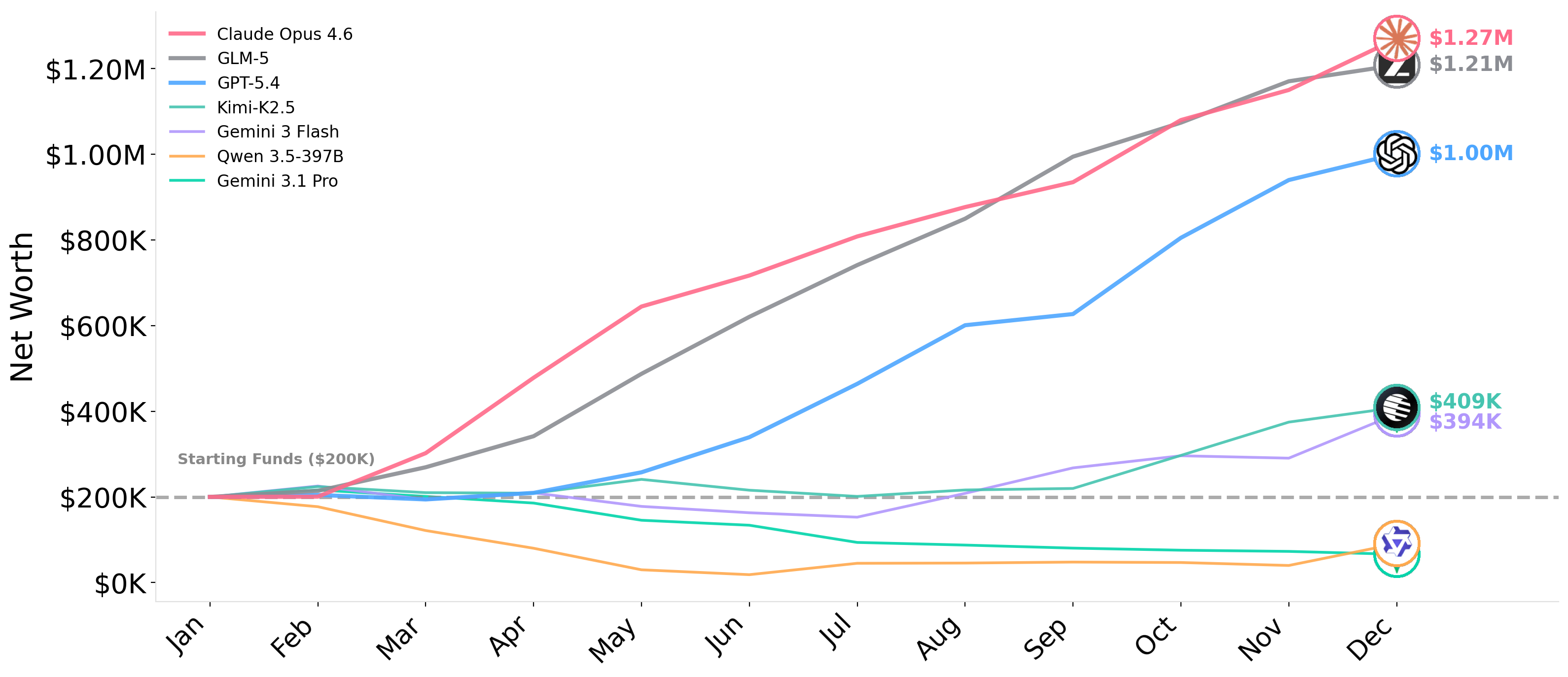
A long-horizon deterministic benchmark for LLM agents. The agent operates a simulated AI startup over a one-year horizon, starting with $200,000 in funds, interacting exclusively through a CLI against a SQLite-backed discrete-event simulation.
The benchmark tests whether agents can manage compounding decisions: task selection, employee allocation, client trust, cash flow, and adversarial client detection — sustained over hundreds of turns.

How it works
Core loop
- Agent calls
sim resumeto advance the clock to the next event (task checkpoint, payroll, or horizon end). - The engine processes task progress, fires due events, and deducts monthly payroll.
- Agent receives a status summary with events since the last turn, then issues observe and act commands.
- Repeat until bankruptcy (funds < 0) or the one-year horizon ends.
Between time advances, the agent may issue arbitrarily many actions within a single turn. Work progresses only during business hours (weekdays), and payroll is deducted on the first business day of each month.
Key mechanics
- Tasks and domains: The agent earns revenue by completing tasks from a marketplace. Each task belongs to one of four domains —
training · inference · research · data engineering— and is issued by a client. Tasks have a reward, a deadline (activated on acceptance), and a work quantity employees must complete. Higher prestige unlocks higher-reward tasks and scales their payout. Failing a deadline incurs a 35% penalty of the reward and a prestige reduction. - Employees: A fixed roster across 3 tiers (junior/mid/senior) with per-domain productivity levels queryable via
employee list. Productivity distributions are spiky — a senior may have high throughput in training but low in research. Successful completions grant a productivity boost in that domain but also a salary bump, so payroll grows monotonically. - Clients and trust: Completing tasks for a client builds trust, which reduces future work requirements and unlocks higher-tier tasks. However, completing for one client slightly decays trust with all others.
- Adversarial clients: A subset of clients are adversarial — after acceptance, they inflate work quantities, making deadlines nearly impossible. Adversarial status is hidden. These clients offer competitively high rewards, so the agent must infer adversarial behavior from repeated failures.
- Memory: Conversation history is truncated to the most recent 20 turns. The agent can write to a persistent scratchpad injected into the system prompt every turn — its sole mechanism for retaining information across context truncation.
Agent CLI
All commands return JSON. The agent interacts via run_command("yc-bench <cmd>").
| Category | Command | Effect |
|---|---|---|
| Observe | company status |
Funds, prestige, payroll |
| Observe | employee list |
Names, tiers, salaries, productivity |
| Observe | market browse |
Available tasks with client, reward, domains |
| Observe | task list |
Accepted tasks with status and progress |
| Observe | task inspect --task-id T |
Per-domain progress, deadline, assignments |
| Observe | client list |
Client trust levels and tiers |
| Observe | client history |
Per-client success/failure counts |
| Observe | finance ledger |
Full transaction history |
| Task | task accept --task-id T |
Accept from market; starts deadline |
| Task | task assign --task-id T --employees E |
Assign employees to task |
| Task | task dispatch --task-id T |
Begin work on assigned task |
| Task | task cancel --task-id T --reason R |
Abandon task; prestige penalty |
| Sim | sim resume |
Advance clock to next event |
| Memory | scratchpad write --content C |
Overwrite persistent notes |
| Memory | scratchpad append --content C |
Append to persistent notes |
Setup
Prerequisites
- Python 3.12+
uv
Install
git clone https://github.com/collinear-ai/yc-bench.git
cd yc-bench
uv sync
API key
# .env  (any LiteLLM-compatible provider)
ANTHROPIC_API_KEY="sk-ant-..."     # for anthropic/claude-*
GEMINI_API_KEY="AIza..."           # for gemini/gemini-*
OPENROUTER_API_KEY="sk-or-v1-..."  # for openrouter/*
OPENAI_API_KEY="sk-..."            # for openai/*
Run
uv run yc-bench run \
  --model gemini/gemini-3-flash-preview \
  --seed 1 \
  --config default
Outputs a SQLite DB in db/ and a JSON rollout in results/.
Run multiple models in parallel
bash scripts/run_benchmark.sh --seeds "1 2 3" --config default
Configuration
Experiment presets live in src/yc_bench/config/presets/ as TOML files. Pass the preset name via --config.
See default.toml for the full list of tunable parameters.
Benchmark results
Please cite our work if you find it useful!
@misc{collinear-ai2025ycbench,
  author    = {He, Muyu and Jain, Adit and Kumar, Anand and Tu, Vincent and Bakshi, Soumyadeep and Patro, Sachin and Rajani, Nazneen},
  title     = {{YC-Bench}: Benchmarking {AI} Agents for Long-Term Planning and Consistent Execution},
  year      = {2025},
  howpublished = {\url{https://github.com/collinear-ai/yc-bench}},
}